
Clearing Drains Before the LA Rains — Step by Step
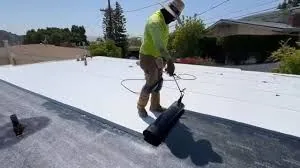
What to do about a flat roof in Sherman Oaks in the first forty-eight hours, and what to leave until Monday.
After a storm the useful work happens in the first two days, and most of it is documentation rather than repair. This is what to do about a flat roof in Sherman Oaks once the wind drops.
What actually matters
Ponding is the beginning of most flat roof failures. Water standing more than forty-eight hours after rain is a defect, not a quirk of the building. It adds load, accelerates breakdown of the membrane, and in this climate leaves a mineral crust that holds the next rainfall in exactly the same place.
What to do in the first forty-eight hours
Document before you touch anything: wide photographs to establish the property, then close photographs of each item of damage, all dated. Drainage does not fail in the storm; it fails in the eight dry months beforehand. A drain that has been dry since April collects grit, leaves and debris, and nobody looks at it until water is coming through a ceiling. A tarp fixed through sound covering creates damage that was not there before.
How Sherman Oaks changes the answer
Pacoima sits on the flat below Sherman Oaks, where the ground is level, the summers are long and hot, and Sherman Oaks wind runs straight through with nothing to slow it. Those wind events are the single most common reason we get storm calls out of this area. Older single-storey stock alongside newer infill, and the failure patterns on each have almost nothing in common.
What we look at on an inspection
- Fall across the roof, and any area holding water beyond forty-eight hours
- Drain and scupper clearance, including underneath every strainer
- Membrane condition across the whole field, not only at the edges
- Flashing at every penetration, curb and item of rooftop plant
- Parapet termination and counterflashing along the full perimeter
- Insulation moisture, established by probe rather than by eye
- Evidence and quality of previous patching
Common questions
Should I get a tarp on it straight away?
Only once it is photographed, and only if it can be fixed without putting new holes through sound covering. A badly fixed tarp creates damage that was not there before.
How soon do I need to report it?
Check your policy, because most impose a reporting window. Reporting early costs nothing and protects the claim.
The honest summary
Ponding, blocked drainage and failed penetration detail account for nearly every flat roof call we take. If a quote does not mention drainage, it is a quote to recreate the same problem in a new material. In Sherman Oaks the thing to watch is wind-side edge detail, ridge fixing, and how much the drainage is carrying.
Free inspection, drone photography where access is difficult, and a written estimate with deck repair priced per sheet. No obligation.